Future decision makers

One of the enjoyable aspects about being a writer is that I sometimes have the opportunity to visit schools and talk to students. More to the Story – conversations with refugees has been out in the market for over three years now but it is still being used in a number of high schools around Australia for English, social sciences and several other subjects. The response from students and teachers continues to be heartening.

Recently I visited Churchlands Senior High School in Perth and was so impressed with how the teaching staff were approaching the topic.  Apart from reading chapters of my book (which was lovely to see), some had examined speeches by Julian Burnside QC, others had examined different writers on refugee issues, or the work of a refugee rapper from South Sudan. Students spent time looking at different media reports to understand the power of language and how it is used to empower and disempower.

The overwhelming message from students about how Australia treats asylum seekers is one of astonishment and outrage.  As one young student said to me: ‘I just can’t understand why we treat people like this – it is a fundamental human right to be able to seek asylum.  How does this happen?’

The students wanted to know about Operation Sovereign Borders and what I thought would be a reasonable intake of refugees each year.  I explained the average of 13,000 people wasn’t enough for a large, rich country like Australia and, for me, 100,000 – a similar number to Canada – would be more appropriate.  I also reminded students that they didn’t have to agree with me, and they could build their own positions supported by facts.  The students are examining all the positions that people take on refugees and asylum seekers in Australia and will be working on their own persuasive essays in the coming weeks.

Perhaps the most interesting question was whether I thought attitudes were better now compared to when I returned to Australia ten years ago.  Sadly, I don’t think they are.   Australia remains a contradiction to me.  It is a great multicultural country where people from all over the world live and work happily, but there are pockets that can sometimes become loud and spiteful. I think our obsession with refugees who come by boat and how we treat asylum seekers has hardened over the years.

In fact, I think Australia’s position is dehumanising and mean and violates Australia’s obligations under international law.

That said, one class asked me if I was optimistic about future changes to the legislation and attitudes.  I am, because the decision makers will be young people like my classes.  They are respectful and welcoming to many different nationalities and backgrounds in their classroom. The future is theirs to shape.

Book cover

A man of vision

Twenty-one years ago, a man saw a great need for more education-based services for people from refugee and migrant backgrounds and Aboriginal and Torres Strait Islander people. He could see how to make people more welcome, and with decades of teaching experience, he knew how to help people bridge the gap from being “a new arrival” in Australia to becoming a contributing member of society.

I write of Steve Bowman, the retiring director of the Edmund Rice Centre, in Western Australia. I am privileged to serve on the board of this “grass roots”, community, not for profit organisation that continues to make a difference in thousands of lives.

I first became aware of Edmund Rice when I was writing More to the story – conversations with refugees.   As I was starting to research and learn more about the community service groups that helped refugees, so many people said to me: “you must go and talk to Steve at Edmund Rice; they do great work.”  They were right. I walked in the door to do an interview and have stayed involved ever since.

You can find more information about the Centre and the valuable services it provides at www.ercwa.org.au.  For this post however, I want to focus on Steve and the power of his vision.

A former Christian Brother, Steve worked throughout Western Australia including significant time in the Pilbara and Kimberley where he found joy in teaching people from a different culture to his own.  He also spent time travelling, studying and volunteering with different organisations in Sydney, Ireland and the United States.  He describes this time as one of spiritual richness and reflection.

On his return to Perth with a determination that has become his trademark, and with the support of the Christian Brothers, he opened the doors to a building in Perth’s northern suburbs that would become the Edmund Rice Centre WA.

Steve was inspired by the life and vision of Edmund Rice, the Irish businessman who more than 200 years ago responded to the needs on his doorstep by dedicating his life and resources to the liberation of the poor through education.  Along with volunteer teachers and helpers Betty and Alan O’Neil, Pat Chinnery, Sue Catling, Mary Britton, Matt Lobo and Brothers Geoff Seaman, Peter Thrupp and Phil O’Loghlen, they taught English, computer, skills and art and craft classes to newly arrived refugees.

In the process, they created what Steve called “common ground” where people of all faiths, cultures and backgrounds could come together and learn. Clients over the years have described the Centre as “their family” and “a place where they belong.”

From three classes a week with 24 people 21 years ago, the Edmund Rice Centre now welcomes over 75 people a day to over 1,000 classes of English per year.  Hundreds more take part in other community classes and thousands of young people participate in sport, arts and youth leadership programs.

Steve became a leader in the sector and the wider community, as he built an organisation with an unprecedented reputation for providing quality service to some of the most marginalised people in the community.

At his recent farewell morning tea, one of the many people who asked to speak said  “One of the many things I learnt from Steve has been the need to be present, the need to listen and the need to be compassionate.”

Steve Bowman inspires me and reminds me often that if everyone took just a little time to contribute to their communities in some way, we would make the world a better place.

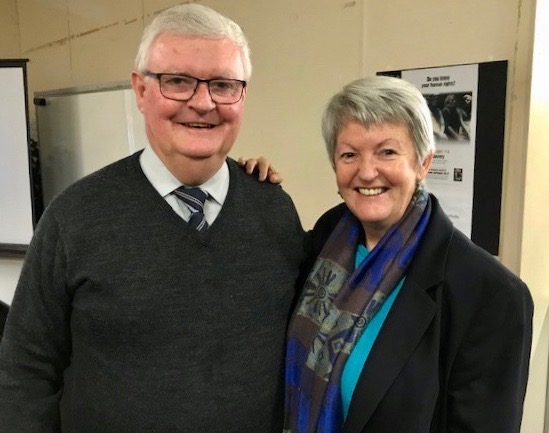
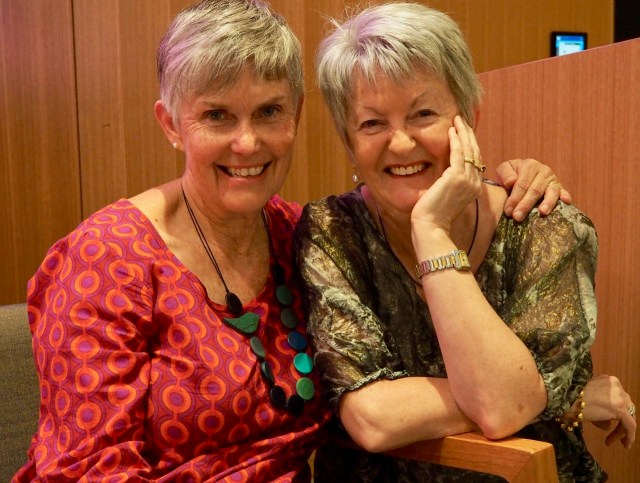
steve and I (1)

A world of stories


Refugee Week, 16 -22 June, provides a wonderful opportunity for people around the world to celebrate the contribution refugees make to our society.  It’s also a time to raise awareness, remembering and honouring the often-perilous journey that refugees have taken to reach Australia and other countries.

Logo

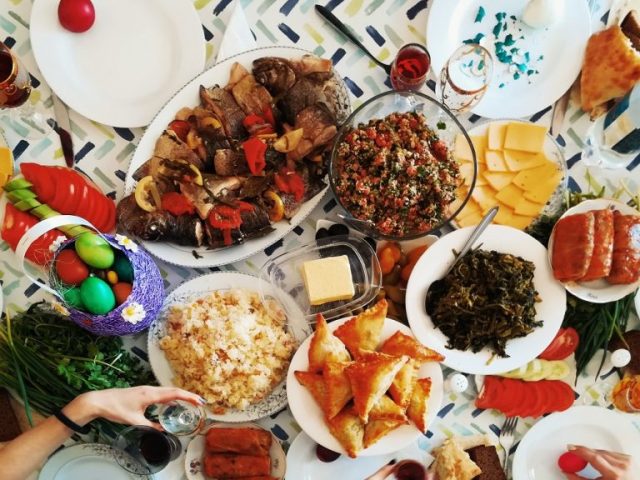
For many people, Refugee Week provides an opportunity to meet a refugee for the first time. This year’s theme for Refugee Week is A World of Stories which makes food the focus and asks you to “Share a meal, share a story…”  With that in mind, the Refugee Council is encouraging businesses, community groups, schools, and individuals to hold a food event (breakfast, morning tea, dinner) where they can hear stories from this year’s Refugee Ambassadors, while sharing some of their favourite meals. This can be done by either inviting a refugee to your event, watching a video or listening to stories in other ways.

There’s a lot of information on the website and similar organisations around the world also provide advice.  If you are planning an event in Western Australia, I can highly recommend the speakers bureau at the Youth Affairs Council of WA.  For a modest fee, a young person is available to talk, share their story and answer questions.

There are many public events around the world for Refugee Week.   If you do nothing else, take time on World Refugee Day on 20 June to look out for some stories such as this one about a woman whose parents came to Australia after the second world war.

Or you could buy a book.  Behrouz Boochani’s book about his imprisonment on Manus Island No friend but the mountains  is excellent, or They cannot take the sky, a collection of direct testimonies as stories, is also a thoughtful read. I have a suggested reading list on my website you may like to investigate.

I will be thinking about my new friends – those refugees who entrusted me with their stories, and the positive lives they have built for themselves here in Australia.

gor-davtyan-share-a-meal-02-768x576

What next?

After four years of hard work I have finally submitted my PhD about refugee life stories.  It’s been a thoroughly enjoyable experience – well except for the last few months of endless proofreading, formatting and reference checking!

My colleague, Professor Baden Offord, told me at the beginning of my PhD that it would be a time when I could research a project, delving deeply into subjects dear to me, without feeling guilty that I was sitting and reading a book. He was right. What a joy it has been to read books and articles about stories from refugees from around the world.   I have examined the different ways stories are told and the influence this has on us as readers.  I have studied the way stories make their way into the public domain, and, at the same time, I have written my own manuscript-length collection of stories about women from a refugee background.  This writing has also forced me to examine my own role as a narrator and resulted in me telling some of my own story. My two supervisors, Dr Rachel Robertson and Associate Professor Caroline Fleay, are outstanding scholars and contributed to the joyful learning experience.

Eleven women and three men became co-collaborators as part of my writing, and I feel deeply honoured to have been able to work with them to create their stories.  I collaborated with people from Afghanistan, Iran, Eritrea, Sudan, South Sudan, Somalia, Burma and Palestine.  I have learnt so much and been humbled by their honesty and their resilience.  All of them have agency and voice and a story to tell.  I look forward to sharing them with you in due course.

My thesis is now with two examiners for some time so I am waiting in a kind of limbo.  Most people have congratulated me on submitting my thesis and expect me to be out celebrating.   I’m not.  I don’t feel elated. I feel kind of numb.  Apparently, this is a common feeling for many PhD students after something that has engulfed your life for years has quietly disappeared with the push of a “submit” button.

Hopefully I will officially pass sometime this year, then my goal is to turn the manuscript into a marketable book.  It will need editing and a couple more stories will need to be added.  If you are a woman from a refugee background or you know of someone, don’t hesitate to contact me.  I want to help more people to share their stories.

What became clear throughout my research is that we don’t have access to refugee stories in the style that I write. I use direct testimony from people, conversation and historical context alongside my own reflections to entice the reader to think about their lives, as well as that of the person of a refugee background.

My way of advocating for refugee rights is to tell stories and I intend to keep doing this.

I will also be continuing my work on the board of Edmund Rice Centre WA and, now with a little more time on my hands, will look for other organisations where I can volunteer my time and expertise.  So many need “hands-on” assistance as well as donations.

So far, I have been able to maintain my links with Curtin University.   I am joining other writing colleagues to give an academic paper at a conference in Madrid in June and I continue to stay involved with the Centre for Human Rights Education.  I have worked as a research assistant, co-authored one paper about the challenges of accessing higher education as an asylum seeker and am also working on another journal article.

So, whilst waiting for the examiners’ feedback on my thesis, I am taking a short break and then will be back to my life of writing stories and working at a grass-roots level in society to try and make a difference.

Rose Farid Fauz Paul Piok 2016 (1)
I met Farid, Paul, Piok and Fauzia (L-R) when writing More to the Story – conversations with refugees.

World Press Freedom Day

World-Press-Freedom-Day-Quotes-World-Press-Freedom-Day-Images-3

Today is World Press Freedom Day.

Proclaimed in 1993 by the UN General Assembly, 3 May celebrates the fundamental principles of press freedom.  As a former journalist this day means a lot to me. It provides the chance to evaluate press freedom around the world, to defend the media from attacks on their independence and to pay tribute to journalists who have lost their lives in the exercise of their profession.

In this current global climate of ‘fake news’ and misinformation that flies into our phones, our inboxes and our consciousness every day, the importance of independent, professional and properly researched journalism is more important than ever.

This year’s theme “Media for Democracy: Journalism and Elections in Times of Disinformation” discusses current challenges faced by media in elections, along with the media’s potential in supporting peace and reconciliation processes.

The major celebration of World Press Freedom Day is in Addis Ababa at the African Union Headquarters and is jointly organised by UNESCO, the African Union and the Government of the Federal Democratic Republic of Ethiopia.

Locally, PEN Perth is holding an event Spotlight on Colombia at the Centre for Stories. Local Colombian intellectual and PEN Perth committee member Karen Escobar, will comment on the current situation in Colombia by weaving personal anecdote with political commentary, social history, and cultural observation. For more information and to book for the event, please go to the Centre for Stories website.

This event is a part of PEN’s ‘spotlight’ series, which focus on the plight of writers, artists and journalists in countries experiencing hardship and how that might affect responsible freedom of expression, media censorship, and political interference.

I’m also excited to see that one of the leading advocates for press freedom in Australia, and PEN Perth Patron, Peter Greste, will be giving a keynote address on Fake news and false history: The use and abuse of truth and lies at Notre Dame University in Fremantle on 17 May. It’s free and you can book for it via eventbrite.

Wild, weird and wonderful

logo-MRRWF

The Margaret River Readers and Writers festival is fast approaching. Running from 3-5 May, this year they are exploring the theme of wild, weird and wonderful.

I love their description of their program – stories that expand our horizons, make us laugh, ponder, question and smile. It really sums up why I enjoy participating in writers festivals.

I’m involved in three sessions over the festival. On Saturday 4 May at 9:30am I will be starting the day chatting with Ian Parmenter, Gillian O’Shaughnessy and Chris Hammer over coffee and the day’s news. I was lucky enough to be involved in the ‘’Coffee and Papers session last year, and I’m really looking forward to it again this year.

Later that afternoon, I will be presenting a panel discussion around the anthology Women of Certain Age with Jodie Moffat, Susan Sullivan, Liz Byrski and Sarah Drummond.  It’s a lovely book – a collection of stories of identity and survival written as a celebration of getting older and wiser.

And then on Sunday I will be interviewing the always delightful Liz Byrski about her latest novel A Month of Sundays.  As she describes it, it’s a book about her three favourite things – women, books and reading.

Held in one of the most beautiful regions in Australia, the festival is based at the Voyager Estate winery.  And with around 60 writers, journalists, poets, playwrights, illustrators and photographers it really has something for everyone. Tickets are selling fast so if you are interested you will need to act quickly! I hope to see you there.


Harmony, peace and understanding

With Harmony Week over for another year I wanted to focus on the unity and friendship that we all share and highlight some stories from the week’s events that you might find enjoyable.

Harmony Week celebrates Australia’s cultural diversity. It’s about inclusiveness, respect and a sense of belonging for everyone.

In Mirrabooka, located in Perth’s northern suburbs, 112 people from 77 nationalities took part in a drumming circle, which made the Guinness Book of Records.  You can watch the joyful, musical result here.

The dark cloud from the Christchurch massacre hangs over us all still, however there have been remarkable expressions of support for the Muslim community, both in New Zealand and here in Australia.  Here is the link to a story about a Muslim man going to a Mosque and meeting a woman of Christian faith in Canberra.

Of the many celebrations held during Harmony Week, one always close to my heart is the big Harmony Festival in Katanning.  This year they celebrated 10 years for this great community event.  I wrote a chapter about this regional town in Western Australia in More to the story – conversations with refugees, and told the story of John Nazary who lives there.  Katanning is a true multicultural community, the most ethnically diverse regional centre in Western Australia that is home to people from some 50 different language groups.  Katanning has always welcomed refugees and migrants.   You get a sense of their inclusive community from this video on their website.

I hope we can all take the desire for harmony further than this week. Let’s help make our communities, and the world, a better place.

Harmony Week 2019 email footer

Truth Telling

Over 120 people gathered at John Curtin Art Gallery last weekend for the Truth Telling and Taking Action symposium about the current situation for asylum seekers in Australia.  It was hosted by a group of service providers, advocates and the Centre for Human Rights Education at Curtin University.

It was a day of storytelling.

Asylum seekers, on many different types of visas, told of their daily lives and how challenging living on these different temporary visas can be. My overwhelming sense was one of uncertainty and worry.  People wake up every day and wonder whether they will be called in to discuss their visa and if they are safe.

How can Australia torment refugees like this?

There are thousands of people seeking asylum living in the Australian community.  Some of these people have come to Australia by plane and sought asylum afterwards. Some of them have come to Australia by boat. The way they came affects whether they are detained, the conditions of their visas, and how their claim for protection is determined.  It’s very complicated.

The Refugee Council of Australia will be spearheading a major campaign from Thursday 14 March leading up to the Federal election called I Choose to be Humane – treat people like people.  All the presenters described how there is a real opportunity to be heard and make a difference in the next few months.  You’ll be able to access the campaign at www.choosehumane.org.au so register your interest now.

Easy-to-read facts and information are also available from the Refugee Council website.  This is one thing we can all do – be more informed about the debate and people’s lives.

Here’s the definition of some common visa types that might be helpful in understanding this issue.

Bridging visa (BV): Temporary visa granted to allow someone to live in the community while they wait for their refugee claim to be finalised.

Temporary Protection Visa (TPV): Three-year temporary protection visa given to someone who came to Australia by boat and is found to be a refugee. At the end of the three years the holder can only apply for another temporary protection visa.

Safe Haven Enterprise Visa (SHEV):  Five-year temporary protection visa that can be granted to someone who came by boast and is found to be a refugee.  At the end of five years, they may be eligible to apply for a permanent visa if they meet that visa’s requirements, but only if they have worked or studied in a designated regional area for at least 3.5 years.

The symposium coincided with Refuge, a Perth Festival exhibition which runs until mid-April, featuring two poignant and timely works – Candice Breitz’s Love Story and Angelica Mesiti’s Mother Tongue. They both utilise cinema and art to present the complex experiences of their immigrant and refugee subjects through music, performance and the spoken word.

Asylum-Seeker-Protest-Rally

A big weekend of stories and ideas

Regular readers and those of you who know me, understand I am a big supporter of Literary Festivals around the world.   They bring readers and writers together in exchange of stories and ideas.   There’s time for laughter, sadness and reflection.  The Perth Writers Week has just concluded, and I have to say it lived up to expectations.  Here’s some of the writers I interviewed and saw in action which might provide some good reading tips.

What fun I had with children’s writer Dianne Wolfer as we discussed navigating children’s literature at the Perth City Library.   We were lucky enough to have a really engaged group of librarians, teachers and parents attend, all of whom contributed their own ideas and suggestions.  Dianne will be blogging soon about a resource list of ideas she has put together.   I’ll send links once I get it.

Dianne Woolfer and Rosemary Sayer
Dianne Woolfer with Rosemary

The highlight of the festival for me was attending a Sunday breakfast chaired by the fabulous Alan Dodge, former Art Gallery of WA Director and art historian.  Amanda Curtin, Gail Jones and Amy Sackville were the guests and it was a wonderful opportunity to travel through their books each with an art focus.   The conversation was entertaining and informative – it was a really lovely way to spend a Sunday morning.

Alan Dodge, Amy Sackville, Gail Jones and Amanda Curtin

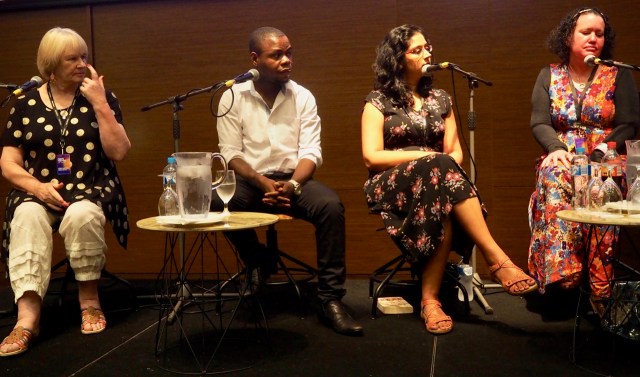
On the last day I chaired a panel with a variety of authors who all grappled with the concepts of freedom, identity and language. Heather Morris, Future D Fidel, Balli Kaur Jaswal and Carly Findlay, are very different people who have written vastly different books. It was interesting however to identify and explore some commonality within the themes we discussed. I highly recommend their books.

Heather Morris, Future D. Fidel, Balli Kaur Jaswal and Carly Findlay

If you have never been to a writer’s festival, look out for one near you.   You can go by yourself or with a friend.  It’s an opportunity to hear from authors and thinkers you know or find new ones to get to know.   You don’t have to do anything other than buy a ticket, turn up and be prepared to enjoy yourself.

Our Imagined Selves

I am settled back at my desk for the new year and working steadily towards concluding my PhD on the life stories of people from a refugee background.

Because of my study focus (anyone who has undertaken a PhD will relate to this) I’ve restricted many other activities for a while. I am, however, pleased to be participating in two sessions at the Perth Writers Week coming up later this month. The theme of this year is Our Imagined Selves, which so perfectly encapsulates to me the process of delving into a great book.

The fabulous Dianne Wolfer and I will be discussing what every parent, grandparent and any other family member needs to know about children’s literature, on the evening of Thursday 21 February at the Perth City Library.  I don’t know about you, but I always scratch my head when it comes to choosing books for the younger members of my family, so I am really looking forward to our chat.  Dianne is an excellent writer and is probably most famous for Lighthouse Girl, but my personal favourite is Granny Grommet and me. 

Then on Sunday 24 February I will be facilitating a group session involving very different people from different countries, with amazing stories. Infinite Worlds, Infinite Words brings together writers Balli Kaur Jaswal, Carly Findlay, Heather Morris and Future D Fidel to discuss the relationships between language, freedom and identity.

One of the aspects I love about this festival is the eclectic collection of writers and topics. We have the outstanding Chinese poet Zheng Xiaoqiong sharing his work and thoughts on the vexed issue of translation; Hugh Mackay and Greg Sheridan in a lively discussion with Bill Bunbury; Benjamin Law, Ursula Martinez & madison moore talking with Ruth Little on challenging narratives of identity and family; and Gail Jones, Susan Midalia and Greg Fleet talking about style, substance and humour with Laurie Steed.

There really is something to suit every literary taste. I hope to see you there!

INFINITE-WORLDS-INFINITE-WORDS-BANNER
Balli Kaur Jaswal, Carly Findlay, Heather Morris and Future D Fidel