Category Archives: Refugee stories

The ever burning candle

The power of telling people’s stories never ceases to amaze and inspire me.

In association with the Centre for Stories, three established playwrights have been working with three local story tellers to bring a portion of their stories to the stage at The Blue Room Theatre. My good friend Fauzia Sufizada is one of those story tellers.

I’m thrilled that Fauzia’s story, which was adapted by Chris Isaacs, an award winning writer who has worked around the world, was primarily inspired by my book More to the Story: conversations with refugees. English is Fauzia’s fifth language and she was brilliant in a solo performance. She asks her audience to imagine her life as someone from a refugee background.

Fauzia Sufizada is lost on a bus to White Gum Valley.  She is in a room in Peshawar watching a Norwegian freighting ship on TV.  She is reading her father’s poetry in Kabul.  She is stepping off an airplane in Perth. She is in a chair in the theatre – and she’s talking to you.

The other two stories that were brought to the stage were equally as engaging.  Due to popular demand an extra show has been scheduled for Saturday 4 August. Click here to make a booking.

Fauzia's play

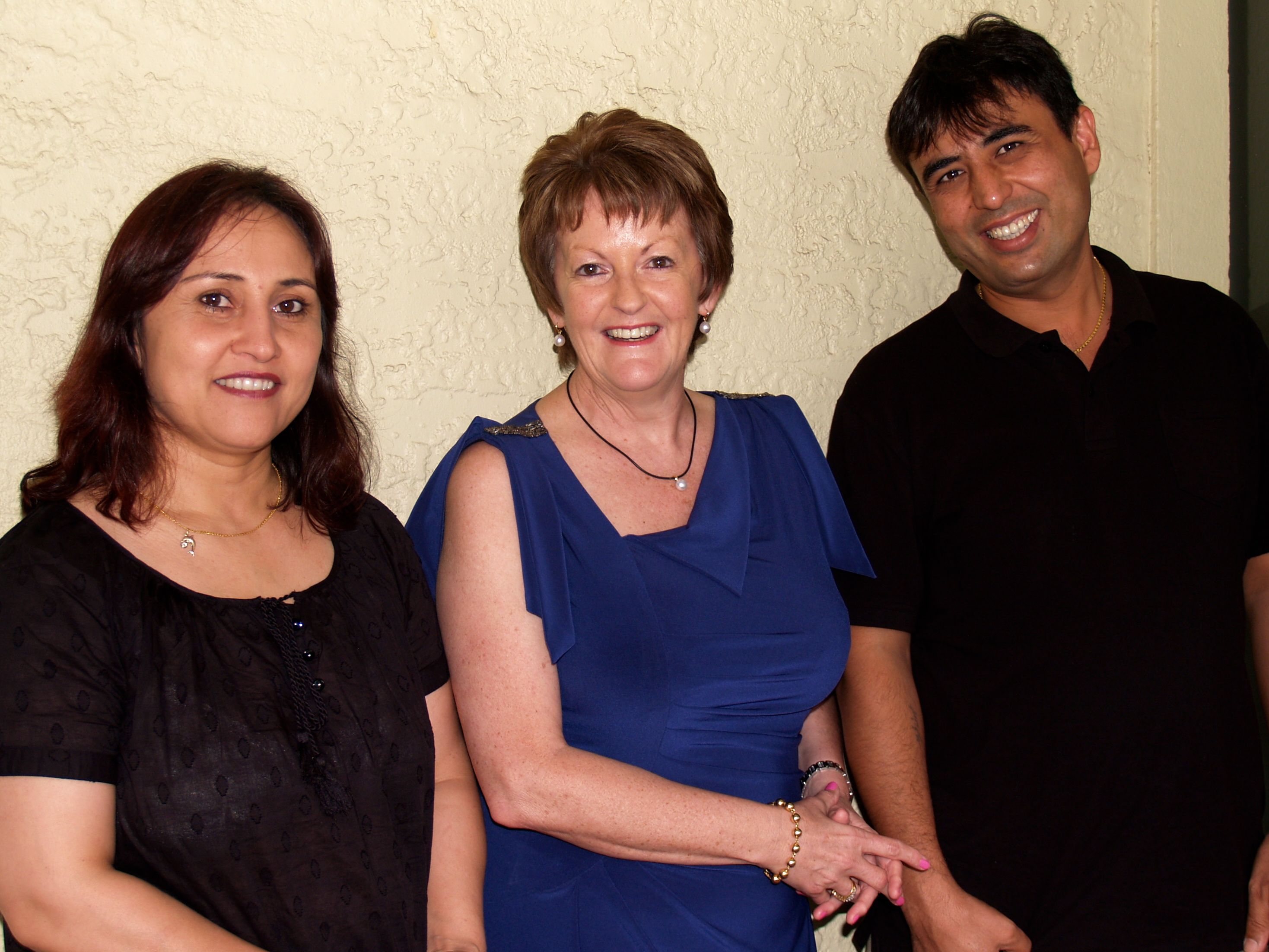
Fauzia Sufizada (third from left) with a few fans after the show

Woman2Drive

This month Manal al-Sharif was planning to return to Saudi Arabia, the country of her birth, to drive freely down the main streets on her own, when a ban on women driving is lifted.

However, as the historic date of 24 June drew closer Manal received death threats while six other prominent human rights activists have been detained in Saudi Arabian prisons.

She decided it is safer for her to stay in Australia where she now lives.  “I think I can be a stronger human rights advocate outside of Saudi Arabia where my voice can be heard around the world. They would lock me up again if I returned,” she said in a recent interview.

Manal has been part of a movement in the Saudi Kingdom advocating for women’s rights and the right to drive a car without a male chaperone. Her memoir Daring to Drive also gives us rare personal insights into everyday life for women in the country.

The book describes her strict commitment to Islam in her younger years and how that slowly changed.  Manal graduated from university with a Bachelor of Science focussed on computer science.  She then secured a position as an information security consultant, one of the few women to do so, at Aramco, Saudi Arabia’s biggest oil company.  It was from this point in time that she sought fearless ways to break through taboos.  It was not easy, as the opening paragraph shows.Manal al Sharif

‘The secret police came for me at 2 in the morning. As soon as I heard the words Dhahran Police Station, I was terrified. My brother slammed the door shut and locked the bolt. There was a pause. Then the knocking started again.’

Manal spent a week in a cockroach infested prison for driving a car.  She did not commit a traffic offence, but the police told her she ‘broke orf’ – a tradition, custom or practice.

When I interviewed Manal at the recent Perth Writers Week, she still seemed a little surprised that her book has become a best seller around the world.  Manal has also been recognised with the Havel Prize for Creative Dissent Award at the Oslo Freedom Forum and Time magazine named her one of the 100 most influential women in the world.

‘I have always wanted to tell my story.  I am a Muslim girl born in Mecca and now I am an activist.  I did not know my story would be of interest,’ she told me.

I can assure you it is… I highly recommend her memoir.

#WithRefugees

refugee week 2018 logo

Refugee Week is an annual activity to raise awareness about the issues affecting refugees. It provides an opportunity for us all to recognise and better understand the courage and contribution of refugees.

This year is the 20th anniversary of Refugee Week in Australia, which runs from Sunday 17 June to Saturday 23 June. Refugee Week coincides with World Refugee Day on 20 June.

There will be events and celebrations everywhere so I encourage you to think about joining in.

The Refugee Council of Australia has chosen #WithRefugees as the theme for Refugee Week 2018. In Australia, it is the responsibility of our Government, as well as each one of us, to ensure people forced to flee their homes from persecution can live with dignity and with hope. Two of the ways “people power” has made a difference this year:

  1. People have been lobbying their local councils to set up refugee welcome zones to begin to connect with everyone in the community through cultural and information events there’s been great success in the areas of Margaret River, Lithgow, Scarborough, Joondalup and Gippsland. If your local council is yet to sign up as a refugee welcome zone, don’t give up.
  2. Thousands of people have helped amplify the voices of the people trapped in offshore detention — including Behrouz, Joinal, Aziz, and Imran— by sharing and liking their stories. Behrouz Boochani won the print/online and multimedia category in Amnesty’s media awards for his journalism from Manus. Please link up to their FB pages and follow what’s really happening in offshore detention facilities and settlement programs.

As the Refugee Council of Australia reminds us:

A ‘Refugee’ is a person; boy, girl, woman or man. Not a label, but a human being with a beating heart, just like you and me.  And the refugee experience can be prolonged. Today there are more refugees than ever, and only by standing together #WithRefugees can we begin to change this.

The year ahead

This time last year I wrote a blog looking back on the previous year for people from a refugee background. In 2018 I thought I would direct my gaze towards the future.

While I don’t have a crystal ball, I hope that 2018 holds the promise of better things for over than 65 million people worldwide, who are refugees, asylum seekers or displaced people. The situation in places like Yemen and Bangladesh reminds us there is much to do.

refugees fleeing - by Mohammed Salem

Photographer – Mohammad Salem

The refugee crisis remains a global issue requiring a global solution. Nearly one in every 110 people is fleeing war or persecution. This cannot be managed by one nation, governing body or multinational organisation alone. I read an interesting article ahead of the 2018 World Economic Forum held in Davos, Switzerland that asked: What if multinational businesses welcomed refugees displaced by social and political upheaval and worked with governing bodies to assimilate them into our global workplaces?

I’ll share one example on the Davos website that recently moved me. After making a 2,300-mile journey to Berlin, Mohammad Basel Alyounes, a Syrian refugee and accountant by profession, was greeted by a German news crew. When asked what he hoped for his new life in Germany, he said, “I want to work for Ernst & Young (EY).” An EY manager in Germany saw the interview, used social media to locate Alyounes — and EY hired him. He now works with their German Diversity Charter refugee support team.

Wouldn’t be great if more companies around the world took this approach?

Some countries continue to do more than others, just as individually some people do more than others. I’ve loved talking to people who have got involved with volunteering and working with refugees. There are some ideas on this website of organisations you could consider helping, either by volunteering time or donating money.

In Australia, our harsh Sovereign Borders policy remains in place and we continue to only accept around 13,000 refugees a year through our humanitarian program (plus a one-time additional 12,000 people from Syria). Canada accept 250,000 refugees per year.

Some bright news in 2017 included the re-settlement in the US of several hundred men who had been detained on Manus Island indefinitely by the Australian government – although many more wait for an outcome. In a recent edition of The Saturday paper there was a particularly moving article written by Imran Mohammad who is a Rohingya refugee held on Manus.

Manus protests

Peaceful protests continue on Manus

Also pleasing is the increasing number of university scholarships being provided to those who came to Australia seeking asylum.

Personally, I feel the number of Australian voices speaking out about inhumane policies in relation to refugees is increasing and getting louder. One of my main hopes for the year ahead is that more people take the time to learn about what is really happening in Australia and around the world.  My go-to resources in Australia are The Refugee Council of Australia and The Guardian Australia which is usually the only newspaper that provides detailed factual reporting about the issues and thoughtful insights. The latest opinion piece from Tim Costello, Chief Advocate for World Vision, comparing his visits to Bangladesh and Manus Island makes sombre reading.

For a global perspective, I follow the United Nations six monthly reports and updates and Human Rights Watch as well as a number of other sites listed on this website.

Sometimes, it is hard to stay positive and not be overwhelmed by the sheer size of the problem, but I always remind myself that making a difference in one person’s life can sometimes be enough.

Recommended reading

While I was on holidays recently I put together a list of some of the most interesting books about refugees that I have found, and added it the website. This reading list is not exhaustive, but it should have something for everyone. My recommended book list includes books about:

  • Personal stories,
  • The Australian situation,
  • The European situation,
  • Fiction, and
  • Other interesting reads.

Some of the books are very new and some were published a while ago. One published over 10 years ago is still a wonderful read – The rugmaker of Mazar-e-Sharif is likely to remain an Australian classic for many years to come. New publications such as The New Odyssey – the story of Europe’s refugee crisis are wonderfully researched, but give you a personal perspective on the current global situation.

I have also included some fiction, as book clubs contact me for recommendations. What is the what by Dave Eggers, for example, is heart breaking but rewarding at the same time. I’m not sure why some book clubs don’t feel comfortable taking on non-fiction – you couldn’t go wrong with Talking about Jane Austen in Baghdad by Bee Rowlatt and May Witwit or City of Thorns by Ben Rawlence.

I’ll keep adding to the list and I would love to hear about other recommendations.

They Cannot Take the Sky

The sky is like a friend for a prisoner, because around you everything is metal fences, but the sky, they cannot take the sky.

These words are from a book of stories from people who have been detained by the Australian government for seeking asylum.  Each person reveals in their own words their journey, daily struggles, their fears, hopes and dreams.

The title of the book comes from Behrouz Boochani’s story.  Behrouz is a Kurdish They cannot take the sky coverjournalist and writer who fled from Iran. He has been in detention on Manus Island since August 2013. He writes and reports from inside the detention centre when he can and has over 4,000 followers on Facebook. A film he shot entirely on his mobile phone about the life and treatment of refugees detained offshore, premiered at the Sydney Film Festival recently.

As I read Behrouz’s story and others by people of refugee background, I moved between admiration for people’s resilience and optimism to despair and anger.

The editors have collated the testimonies of more than 20 refugees from Iran, Iraq, Sudan and Afghanistan. Some have had their claims for asylum granted and have gone on to become outstanding members of the Australian community. Munjed is a surgeon who had to leave Iraq because he refused to mutilate army deserters. Now that our society has decided not to waste his gifts, he is working again and specialising in prosthetic limbs.

My friend Jamila from Afghanistan has also told her story. She was placed in detention as a five year old child with her mother and brother. Thankfully after some time her family were re-united and she now studies law at university in Perth. Others, unfortunately continue to languish in detention.

As Maxine Beneba Clarke writes: ‘This book will make Australians ask –again – of ourselves; what kind of people are we and how did we possibly let it come to this?

The not-for-profit group Behind the Wire is responsible for They Cannot Take the Sky. I suggest you take a look at their website – as well as information on the book they have a podcast, audio stories, videos and a series of portrait photographs. They are also currently running an outstanding exhibition at the Immigration Museum in Melbourne and I certainly hope it tours widely.  It was developed in collaboration with the Museum by Behind the Wire and a volunteer reference committee of individuals with lived experience of seeking asylum.

Singing the book

When a beautiful soprano sang the words Fauzia Sufizada said on her arrival in Australia I did not even try to stop my tears.

I stood still and turned my face up to the sky to let the raindrops fall on it… I will never forget how it felt on my skin and the smell of the wet soil. I looked at Farid and my boys and laughed out loud. I told them I needed a few minutes to just stand in the rain and feel freedom.

These words from More to the story – conversations with refugees were featured in ‘Uncertain Journeys’, a new work by composer Tom Henry and performed recently by the Australian Chamber Choir.

I had the opportunity to meet Tom and he says he drew inspiration for the work from contemporary accounts of separation from home, culture and family common to the refugee experience. He found a copy of More to the story at the Immigration Museum in Melbourne while doing research for his composition and used some words from both Fauzia and Farid’s stories.

The Sufizadas and I feel incredibly honoured to be part of Tom’s moving work, which also features the words of other refugees and extracts from the Ghazals (short sonnet-like poems) by the fourteenth century Persian poet known as Hafiz of Shiraz.

The Choir, under the direction of Douglas Lawrence, will be performing ‘Uncertain Journeys’ as part of a new program around the east coast of Australia before going on tour to Italy Austria and Germany.

The choir has made five CDs and given over 200 performances – many of which have been recorded for broadcast on ABC Classic FM.   We have our fingers crossed that one day we might hear ‘Uncertain journeys’ on the airwaves.

AusChamberChoir2017image