An inspiring Refugee Week

I participated in numerous events to celebrate Refugee Week this year. Some of the highlights included:

  • A terrific talk at the Willagee Library with a very engaged audience;
  • A WA Greens event with Sarah Hanson–Young and many diverse speakers from refugee and non-refugee backgrounds; and
  • An informative and entertaining evening with the Edmund Rice Centre WA hosted by the patron Ken Michael, AC. It was great to see so many people sharing stories and learning about each other as part of the event.

Throughout the week I was reminded often of the power of the story. At the Greens event I interviewed South Sudanese, young leader Friday Ziko in front of an audience of 100 people at the State Library. Friday was born in South Sudan but civil war forced his family to flee to Uganda when he was just a baby.

It was two days walk to what we thought was a safe refugee camp. Mum pretty much carried my older brother on her back, her bag on her head and me in her arms for two days. We got to Uganda but when I was four years old, trouble started again. Rebels started coming in at night and burning people’s homes down.

Friday’s memories of that time are dominated by one feeling — fear; a feeling that has been shared by all of the people from refugee backgrounds that I have met and interviewed.

You don’t know if you are going to eat tomorrow, if you are going to live tomorrow. You don’t even go to school because you don’t know if they are going to come and attack the school. We always had to move and move and move.

Friday and his family came to Australia when he was ten years old and his stories helped us all understand the challenges that new arrivals face.

At the Edmund Rice Centre WA event – “My story, Your story, Our story” – it was wonderful to see how many people from a refugee background and non-refugee background learnt from each other in small groups by sharing their stories and thinking of ways to work together to make Australia a better place for everyone.   One of the key over-riding needs expressed by those from a refugee background was enhancing access to education and language.

It seems to me that story-telling and listening are important ways we can exchange ideas and help us understand so change can occur.
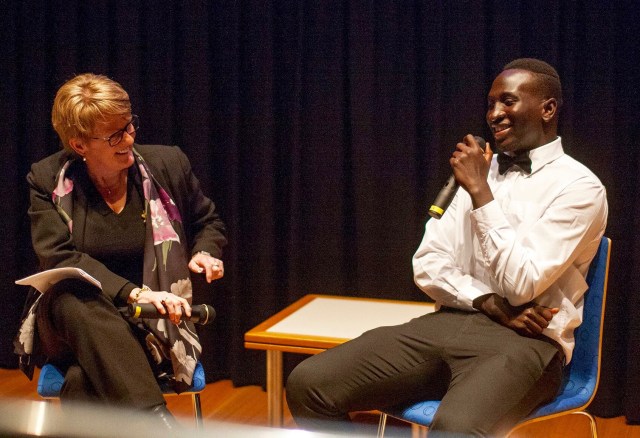
Friday Ziko from South Sudan
Rosemary chatting with Friday Ziko at the WA Greens event celebrating 2016 Refugee Week

Latest global statistics

1 in every 113 people globally is now either an asylum-seeker, internally displaced or a refugee.

UNHCR’s annual Global Trends report, which tracks forced displacement worldwide based on data from governments, partners including the Internal Displacement Monitoring Centre, and the organisation’s own reporting, said 65.3 million people were displaced as of the end of 2015, compared to 59.5 million just 12 months earlier. This is the first time that the threshold of 60 million has been crossed.

The total of 65.3 million comprises 3.2 million people in industrialised countries who at the end of 2015 were awaiting decisions on asylum (the largest total UNHCR has recorded), 21.3 million refugees worldwide (1.8 million more than in 2014 and the highest refugee total since the early 1990s), and 40.8 million people who had been forced to flee their homes but were within the confines of their own countries (an increase of 2.6 million from 2014 and the highest number on record).

Measured against Earth’s 7.349 billion population, these numbers mean that 1 in every 113 people globally is now either an asylum-seeker, internally displaced or a refugee – a level of risk for which UNHCR knows no precedent. In all, there are more forcibly displaced people today than the populations of the United Kingdom, France or Italy.

I was horrified to learn that over half the world’s refugees are children. Here’s what the UNHCR said:

“Children constituted 51 per cent of the world’s refugees in 2015 according to the data UNHCR was able to gather (complete demographic data was not available to the report authors). Worryingly, many were separated from their parents or travelling alone. In all there were 98,400 asylum requests from children who were unaccompanied or separated from their families. This is the highest total UNHCR has seen – and a tragic reflection of how global forced displacement is disproportionately affecting young lives”.

UNHCR summary


Aash Soup for Winter

My lovely friend Fauzia, who runs her own catering company, has recently given me a recipe for her favourite winter-warming soup. I can’t wait to try it.

You can find so many types of vegetable in your fridge and pantry in these days I thought we could make a wonderful Afghan winter soup called Aash soup. Here’s what I use and how I make mine.

Ingredients

  • a small onion chopped finely
  • tomato paste
  • fresh garlic, ginger and chilli
  • cumin, coriander and turmeric powder
  • a small potato
  • a medium carrot
  • half cooked chicken breast
  • a small white radish
  • can of any of the following beans: kidney beans, green beans or chickpeas
  • one bag of any pasta (size 3 will be better)

How to cook

Put a medium pot on the heat and put little olive oil

Add finely chopped onion, salt, garlic, ginger and chilli and fry for five minutes in medium heat

Add the tomato paste, when the onion and pieces looks yellow

Add some cumin, coriander and turmeric powder into the pot

Add cooked chicken breast torn into pieces

Add some water and let them boil lightly until you have chopped your vegetables

All vegetable should be chopped very small and add to the soup and let them boil for about 10 minutes

Add your can of beans in and test for salt

Separately, boil your pasta in a big pot in salty water for 5 mins

Wash it with warm water into a colander

Add the pasta into your soup and boil it for another 3 to five minutes depending on how you like your pasta

Turn of the stove and leave it for 5 minutes

Chop your fresh coriander and even some capsicum, if you like, to decorate. Serve it in individual bowls

Finding their voice

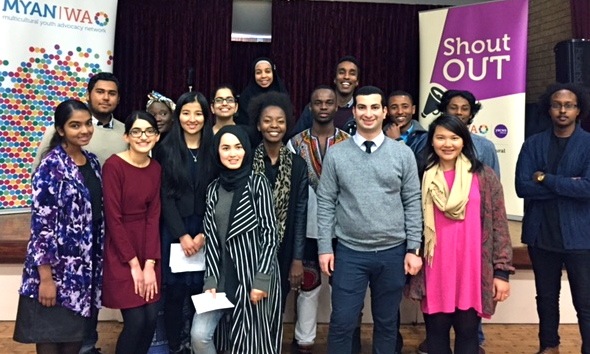
What a pleasure it was to be asked to be part of the public speaking program for young people from a refugee and migrant background with the Multicultural Youth Advocacy Network (MYAN) and the Youth Affairs Council of WA (YACWA).

MYAN WA has introduced a program called Shout Out which aims to promote the voices of young people from migrant and refugee backgrounds. The program offered a wonderful opportunity for people to boost their confidence and improve their skills. Shout Out was run over a number of weekends and involved a range of trainers and mentors lending their expertise. I spent half a day helping these fabulous young people develop their personal stories and public speaking skills.

Every participant has an amazing story that will inspire people. They all presented those stories in polished three minute presentations last week with the aid of Rostrum WA. I couldn’t believe how much they had all improved and grown in confidence as they shared special stories and experiences. It was such a wonderful program and I feel very privileged to have been involved.

MYAN is currently developing a list of available speakers who could be invited to your next event or forum. Isn’t that terrific?  I’ll let you know when it can be accessed.

There are more photos from the final event in the Gallery.

MYAN group 2016
Participants in the MYAN 2016 Shout Out program 

Refugee Week 2016

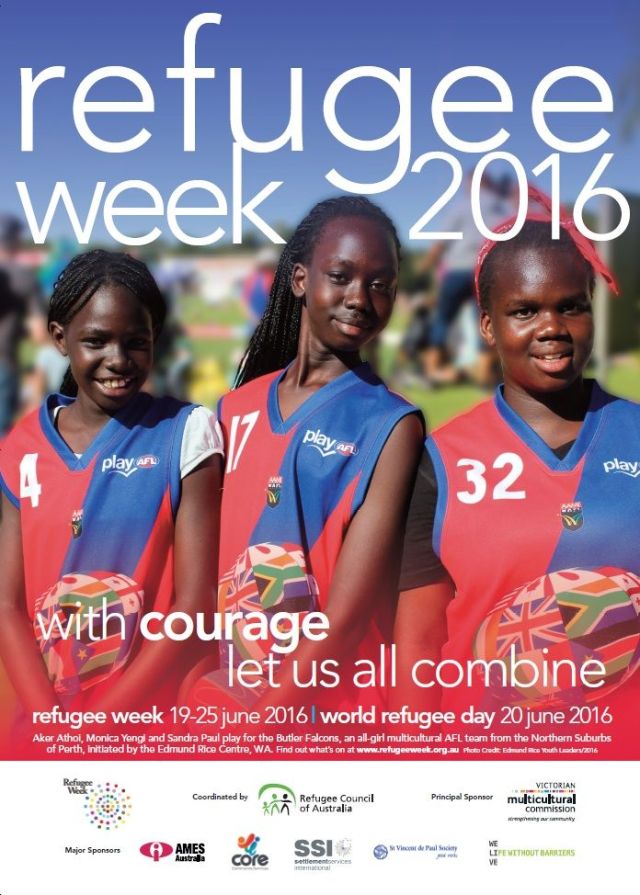
The theme of this year’s Refugee Week celebrations on 19-25 June is “with courage let us all combine” which is taken from the second verse of our national anthem Advance Australia Fair. 

Refugee Week is time that we celebrate the vital contribution and wonderful diversity that refugees bring to Australia. It is also a time when we think about the courage and resilience of all refugees, as well as all those who speak out against persecution and injustice around the world.

World Refugee Day is held every year on 20 June as part of the week and the UNHCR reminds us there are more than 60 million refugees around the world, half of whom are women and children.

The Refugee Council of Australia says: “The week is a call for unity and action for a fairer society. The Refugee Week theme encourages Australians to celebrate the best aspects of our nation’s welcome of refugees, frankly acknowledge unjust treatment of asylum seekers and refugees, and commit to working together to ensure that we do better.”

I’m particularly pleased that the national posters (see below) for this year’s Refugee Week features the Butler Falcons, an all-women’s multicultural AFL team organised through the Edmund Rice Centre here in WA.

For more information about Refugee Week, there’s a dedicated website http://www.refugeeweek.org.au which includes bulletins, posters and events. I’ll also keep you updated about news and events during Refugee Week here on this website.

refugee week 2016 poster