The debate democracies cannot afford to lose

I was delighted to be in the crowd to hear outstanding academic, film maker, journalist and author, Peter Greste give the annual lecture for PEN Perth this week. 

And what a thought provoking and inspiring lecture it was. Titled “Grey zone: the debate democracies cannot afford to lose”, he argued that across the globe, the room for free thought and open debate (the grey zone) is shrinking. Journalists are jailed in record numbers. Writers are muted by accusation of antisemitism and de-platformed. In the name of security and social cohesion, governments extend their powers to restrict dissent.

It was an extremist group who first gave the fragile arena of debate and disagreement a name: ‘the grey zone’. They feared it as the true enemy of their ideology. Yet today, as Peter eloquently described, in trying to contain extremism, democratic governments themselves are eroding that very space—unwittingly serving the extremists’ agenda.

Peter is best known for becoming a headline himself, when he and two colleagues were arrested in Cairo on terrorism charges while working for Al Jazeera. In letters smuggled from prison, Peter described their incarceration as an attack on press freedom.

His campaign for freedom earned him numerous human rights and freedom of speech awards. Now, as an academic, he leads a research program investigating the impact of national security legislation on public interest journalism. Peter is the author of The Correspondent about his experiences in Egypt, and the wider war on journalism. The book has since been turned into a movie starring Richard Roxburgh.  I highly recommend both the book and the film.

The Mustard Pot

I was very pleased to recently have been asked to contribute to a WA anthology of short memoirs. The first collection of its kind in Australia, Ourselves: 100 Micro Memoirs aims to invite the reader into the histories we often edit—or don’t tell—about ourselves.

Published by Night Parrot Press with funding from the WA Department of Local Government, Sport and Cultural Industries this book includes 100 micro memoirs, each 750 words or less, all from WA writers.

Author and journalist Kate Emery shone a lovely and generous spotlight on the book recently in The Sunday Times, calling the collection a ‘a high note’ for WA culture and writing, and good news worth celebrating.

My micro memoir is called ‘The Mustard Pot’ and is about a funny lop-sided mustard pot that my Mum bought me from the Provencal markets and that we used for years and years at our home in France. Here is a brief excerpt:

One day I dropped it and it shattered into hundreds of pieces. Even though it was only a piece of pottery it brought back so many memories of my mum who passed away from cancer ten years ago. The shattered pieces seem to reflect my loss more deeply. I kept telling myself it didn’t matter, it was only an old mustard pot, just a thing that I could easily replace, but this tangible little pot was much more than that…

To purchase the book go to Night Parrot Press, or check out your favourite independent bookshop.

Embracing Vulnerability

I recently co-authored an academic article with my colleague Dr. Susan Beth Rottmann, Assistant Professor at Özyeğin University in Turkey. Susan and I met at a conference in Madrid and discovered we had a mutual interest in writing about the lives of refugees.

Called Embracing vulnerability in writing migrant lives, our article explores how an anthropologist like Susan, and a life writer like me, need to be open to making themselves vulnerable when sharing peoples’ stories.

Vulnerability is not only an experience of migrants and refugees but is also experienced by researchers and writers. Susan and I discuss the ethical and political practice of vulnerability with regards to writing peoples’ stories and how we both used our own stories to enhance the readers’ understanding. Even with our different backgrounds, we found lot of common ground in our approaches. We also look at the risks associated with this kind of approach – one which does attract criticism.

When there is trust, the vulnerable storyteller, the vulnerable narrator, and the vulnerable reader open the door to different ways of imagining a fairer and more just society.

Susan draws heavily on her fascinating research over many years with German-Turkish migrant women and Syrian refugees. She focusses particularly on one story about her friend Leyla which was published in the 2019 book In pursuit of belonging: forging an ethical life in European-Turkish spacesI draw on my research and writing experience with people from a refugee background who have settled in Australia, using examples from More to the story – conversations with refugees and my research for my doctorate on refugees and life writing.

I’m very pleased that our article was recently published in the prestigious journal a/b: Auto/Biography Studies. While you would generally need a paid subscription, the publisher has provided me with some free online copies to share with my network. So, if you are interested in reading the full article, you may be able to access it via this link

Having afternoon tea with (L-R) Farid, Paul, Piok and Fauzia, some of the people who shared their story with me for More to the story-conversations with refugees

Everybody Belongs

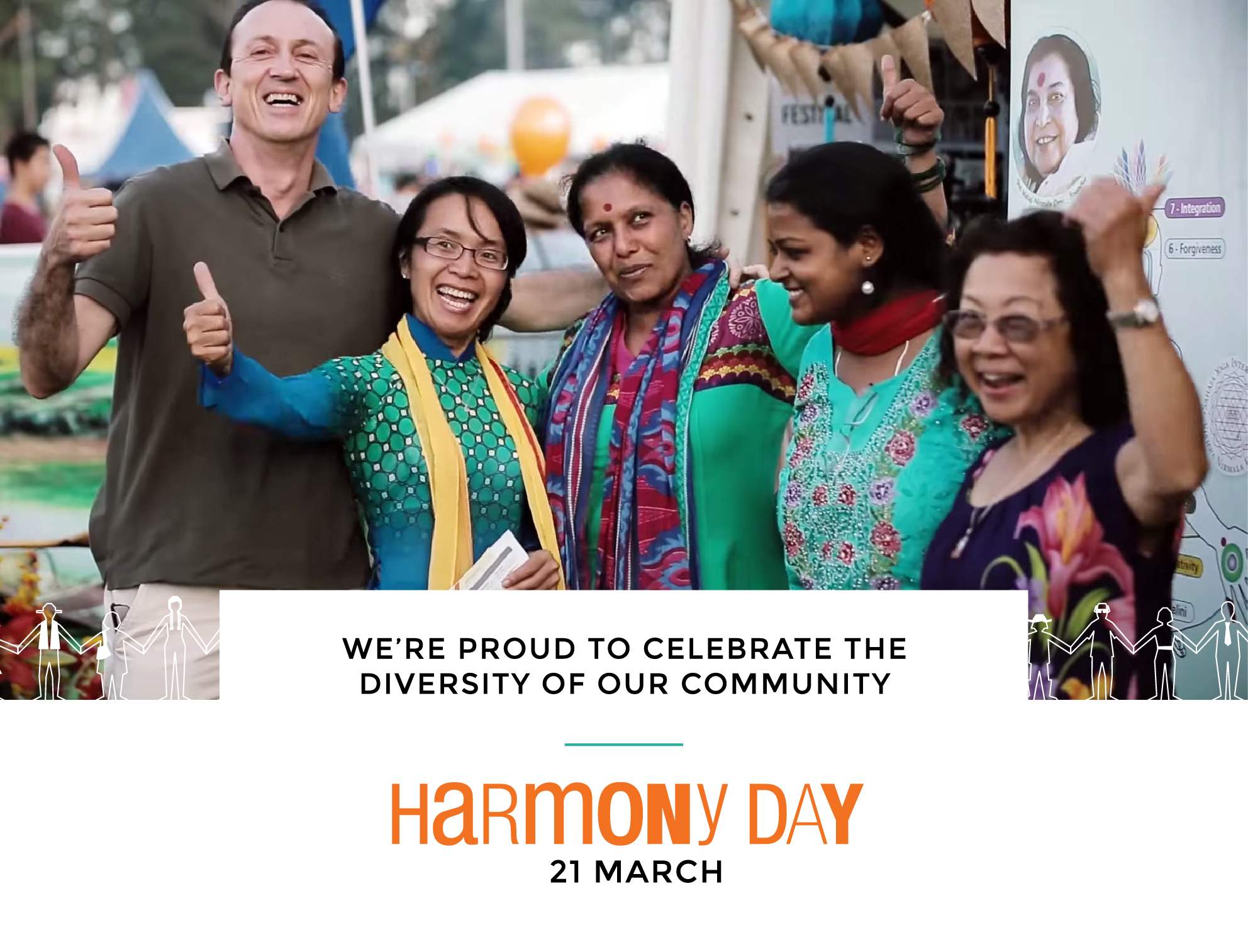
Australia is a vibrant and multicultural country — from the oldest continuous culture of our first Australians to the cultures of our newest arrivals from around the world.  This Harmony Week 15 – 21 March, that is worth celebrating.  

We especially come together to celebrate Harmony Day on 21 March. Created in 1999 to celebrate unity and diversity, Harmony Day was originally an Australian celebration but is now marked worldwide by conscientious citizens. The continuing theme of Harmony Day is Everybody Belongs.

Here are nine stories that will inspire you during the week. Called Food, Faith and Love in WA they were put together by the WA Office of Multicultural Interests and one of my favourite places, the Centre for Stories

An integrated multicultural Australia is an integral part of our national identity. All people who migrate to Australia bring with them some of their own cultural and religious traditions, as well as taking on many new traditions. Collectively, these traditions have enriched our nation.

There are some fascinating statistics about Australia’s diversity that can be good conversation-starters:

  • Nearly half (49%) of Australians were born overseas or have at least one parent who was,
  • We identify with over 300 ancestries,
  • Since 1945, more than 7.5 million people have migrated to Australia,
  • 85 per cent of Australians agree multiculturalism has been good for Australia,
  • Apart from English, the most common languages spoken in Australia are Mandarin, Arabic, Cantonese, Vietnamese, Italian, Greek, Tagalog/Filipino, Hindi, Spanish and Punjabi.

It’s been heartening to see sport and the arts around the world unite in anti-racism messages over the last several years.  Teams make a stand on the pitch/ground/court before every game. Sport transcends culture. It breaks down barriers and helps to build inclusive communities. Sport brings people together by sharing a common goal.

Our cultural diversity is one of our greatest strengths and is at the heart of who we are. 

It makes Australia a great place to live.

Vale Joan Didion

Joan Didion, the eminent journalist, author and anthropologist of contemporary American politics and culture, died at her home in Manhattan over the Christmas period at 87 years of age. 

One of my favourite authors, Joan Didion was a singularly clear, precise voice across a multitude of subjects for more than 60 years. She was also one of the people who inspired me to be a writer.

A standout female figure in the very male New Journalism movement alongside Tom Wolfe, Truman Capote and Gay Talese, Didion cast her precise, coolly-detached eye over both society and her own life in writing that was collected in books including Slouching Towards Bethlehem, her sharp-eyed journey through the promise and dissolution of California’s 60s counterculture, and The White Album, which began in her economic, astute style with, “We tell ourselves stories in order to live.”  I used this quote often in my doctorate studies as it seems to capture the very essence of who we are. 

From an early age I wanted to create my own stories and was constantly scribbling ideas on the back of old inventory paper that Dad brought home from his job at the local council. High school English and literature classes fueled my desire to write and although I enjoyed my creative writing classes with the sharp-minded Elizabeth Jolley at university, I found myself being drawn towards the study of journalism and politics. I imagined myself as a younger version of Joan Didion, writing pithy articles that would attract thoughtful readers frequenting cafes and libraries. Of course, I never came close but went on to have a moderately successful career as a journalist. After a succession of different career choices that involved business suits and brief cases, I ended up back where I started as a child, once again scribbling ideas on pieces of paper, and trying to make words into sentences, sentences into paragraphs and paragraphs into stories.    

I write about people because the journalist in me wants to know every intricacy about a person and find the answer to five key questions that fire my curiosity – who, what, why, when and how. Thus, when I ask a person to let me into their lives, I try to enter with respect, compassion, honesty, and fairness. These values are central to me and who I am as a person. Joan Didion seemed to share similar values. 

If you haven’t read her classic The Year of Magical Thinking about the grief of losing her husband, I recommend you add it to your reading list.

Joan Didion

Australia must do more

The Australian government has made much of its assistance to Afghan refugees claiming it has already accepted 3,000 refugees from the country. What they don’t say is that the 3,000 is simply a part of our existing humanitarian intake of just 13,750 places. 

We have done nothing extra to help a country and its people in crisis. Nothing.

The Refugee Council of Australia is calling on the Australian Government to provide an additional 20,000 humanitarian visas to refugees from Afghanistan in its new brief

What’s the scale of the problem? At the beginning of 2021, 2.6 million citizens of Afghanistan were refugees, 239,000 were seeking asylum and 2.9 million were internally displaced. The Taliban’s takeover of the country, culminating in the capture of Kabul in August 2021, is resulting in ever-increasing displacement. By September 2021, UNHCR had reported 22,120 newly arrived refugees in neighbouring countries and 592,531 people internally displaced since January 2021.

Many more people in Afghanistan are yet to be displaced but fear for their lives because of their work as women’s rights activists, human rights defenders, government officials or staff employed by embassies or western armed forces or because of their religion, ethnicity, or sexual orientation.

For a personal view read the story written anonymously for the Guardian newspaper by a young woman in Kabul who was burning and hiding all her educational certificates in fear of the Taliban. 

So as an affluent and safe country, Australia must do more. Helping just 3,000 people is not enough. The Refugee Council is lobbying the government to accept 20,000 refugees. We have done it before when we assisted Chinese Vietnamese and Syrian and Iraqi refugees in crisis. 

We have a long relationship with Afghanistan. Over 20 years, Australia deployed 39,000 defence personnel to Afghanistan at a cost of $10 billion and spent $1.9 billion on projects to support women’s empowerment, human rights, education, health, and good governance. 

We can’t just sit by and let all our excellent work disappear under the hands of the Taliban. We need to step up and match the work done by other countries around the world.

Accepting 3,000 refugees is not enough.

We could have done better

During the two decades in which Australia was ensnared in an unwinnable war after trailing the US into Afghanistan, successive Australian leaders like Julia Gillard, Tony Abbott and Malcolm Turnbull all spoke reassuringly about how they would not desert the Afghans.

However, this is exactly what we have done.

Afghan friends following the unfolding drama in their former homes can’t believe that after all the fighting, after everything they and their families went through the Taliban is back. Violence, discrimination and persecution of women and young girls has returned. 

The Taliban is stronger right now than at any time since the US invasion. The United Nations reports record civilian casualties. In recent weeks, the militants have stepped up offensive in key cities Lashkar Gah, Kandahar, Kunduz and Herat.

This is critical. The Taliban has strongholds in rural areas but taking back cities is a decisive change potentially tipping the balance of power in its favour. Foreign Policy magazine this week said: 

“The urban offensives also have demographic implications. If the Taliban seize cities, the insurgents would bring an even more sizeable share of the population under their control.”

Australian journalist Stan Grant who worked as a foreign correspondent in Pakistan and Afghanistan has written thoughtfully about the issue based on his experiences

In 2014, former Australian Army Colonel and defence strategist for US General David Petraeus and Security Advisor to Condoleezza Rice, David Kilcullen, forecast exactly what is now happening in Afghanistan. “The worst-case scenario is not that ISIS and al-Qaeda continue to be rivals, it’s that they pal up. You end up with a precipitated withdrawal from Afghanistan, creating space for the Taliban to come back, just like ISIS did in Iraq.”

Kilcullen continues to write about the situation.

I pictured an Australian soldier today, back from extended tours of duty in the Middle East, watching the news on television. The hard-fought battles to defeat the Taliban in places like Uruzgan province and to then improve security and assist villagers re-build their lives, must have seemed a complete waste of time. The country seemed to be back where they had started from. Right in front of them on the screen all the good work that he or she thought they had done, was unravelling in fast moving pictures. 

Several years ago, at the Byron Bay Writers Festival, I interviewed Major General John Cantwell, Commander of Australian Forces in Afghanistan in 2010, and I asked him was the effort by Australian, and allied forces, worth it? What had we achieved in Afghanistan? Was it worth all the lives that had been lost? Cantwell answered that even though such comments seemed disrespectful to a life-time soldier, steeped in a sense of duty and service, he had to answer, “No. It wasn’t worth it.”

The whole mess has been summed up in the Guardian Australia by writers Paul Daley and Ben Doherty as a tragic and wasted opportunity. 

We could have done more. 

We could have done better. 

We’ve let the people of Afghanistan down.

Imaginary encounters

I was recently invited to join a group of writers to visit the exhibition of Everything is true by Abdul-Rahman Abdullah at the John Curtin Gallery at Curtin University.  Our goal was to each produce a short piece of creative writing in reaction to one of the artist’s sculptures.  Organised by Associate Professor Rachel Robertson at Curtin University, I was pleased to be part of such a writing adventure. 

Eleven writers shared their work with an attentive audience at a function at the gallery. Each of the readings – imaginary encounters- were quite different.  Mine was written about a 2019 sculpture called ‘Little Ghost’.

Abdul-Rahman Abdullah is an Australian artist whose practice explores the different ways that memory can inhabit and emerge from familial spaces. The exhibition runs until mid-April.

Little Ghost

I see you.  Why can’t you see me?  I am human just like you except I live in a war zone.   The bombs fall every day and sometimes they hit near my house or my Auntie’s house next door. Usually, the air echoes with a warning siren and we all run toward the underground cellar when we hear the planes.   

My brothers know what sound each plane from each country makes. I am not sure there is any difference.  It didn’t matter when my mother was hit returning from the market with fresh fruit and vegetables in her basket.  The bomb sliced through her body.  Her blood seeped into the sand staining it like rust. Random tomatoes and apples rolled across the ground. 

It wasn’t safe to get her body from the street for hours. My father carried her over the potholes and the past the bullet ridden houses to bring her home for us to bury. I cry every night for mama.  

My grandmother makes me cover up hoping it will keep me safe from the eyes of the invaders. But she doesn’t know she has made me invisible to everyone else.   I am so alone under my cloth.  I weep my silent tears among the voices.

Little Ghost by Abdul-Rahman Abdullah

Amina’s story

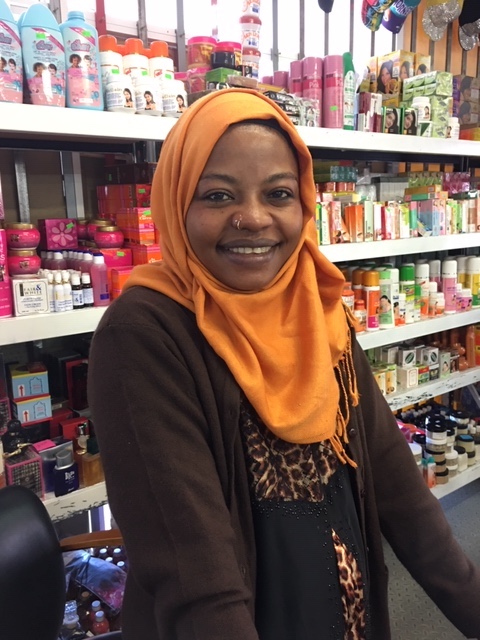
“Australia is my home now, not Sudan.  Everything is normal here.  People don’t have guns pointing at you and your family.   I feel safe,”

Amina is a refugee from Sudan who escaped persecution to come to Australia with her husband and children.  After a very difficult decade for the family, in 2000 Amina’s husband explained to his family that they must escape from their country.  They could all see the violence was worsening.  Amina sighed and quietly told me: ‘you can’t live like that.’

“Our family needed to be safe and away from all the fighting.  We were locked in our home a lot of the time.   Villages, and even people, were being set on fire around us.  My husband travelled ahead of us to secure somewhere safe in neighbouring Egypt.  I was glad to get out.  I was scared of the violence, but I was also scared of what the future would hold for my family.”

Everyone settled in Egypt as best they could and seven months after fleeing the horrors of Darfur and claiming refugee status through the UNHCR the family were accepted as refugees by Australia for re-settlement.

“I didn’t know what to expect.  This country called Australia seemed so far away and we were leaving my mother, father, brother, and other family behind.  When we moved into our first rented place in Perth, we had nothing.  No furniture – nothing.  I couldn’t imagine how we were going to manage in this strange country as I spoke no English.  I persevered and gradually I began to feel better.  Australia was normal and safe.  There was nobody with a gun.”

She made an effort to become involved in new things and joined the language classes and other activities at the Edmund Rice Centre WA. “It opened my eyes to how life could be. Everyone was so friendly.   No-one was judgmental and it didn’t matter what country you came from, or what your religion was everyone was treated equally. It was like a big family. I knew I had found my place.  I had a family again.  I belonged.

Amina was very motivated to learn and grew in confidence working in a variety of different jobs as well as alongside her husband in his business over many years. Recently she decided to seek another employment opportunity in aged care. She gathered all her study certificates, most of which are qualifications for working with the elderly, wrote a resume, was offered an interview and was ultimately successful, returning triumphantly to celebrate her new job with her friends and family.

Amina has seven children who are all doing well at school and university.   Her husband owns and manages a retail outlet and they have called Australia home for nearly 20 years. I thought back to how Amina described herself when she arrived in Australia as a frightened, lonely woman who knew no-one. Over the years she has studied to become a successful businesswoman with a close knit, loving family.

“Of course, I am much happier now.  We are settled and in our own home and we have become Australian citizens. I’m still tired with all the work, of course, but that’s ok most of the time.”

New Voices

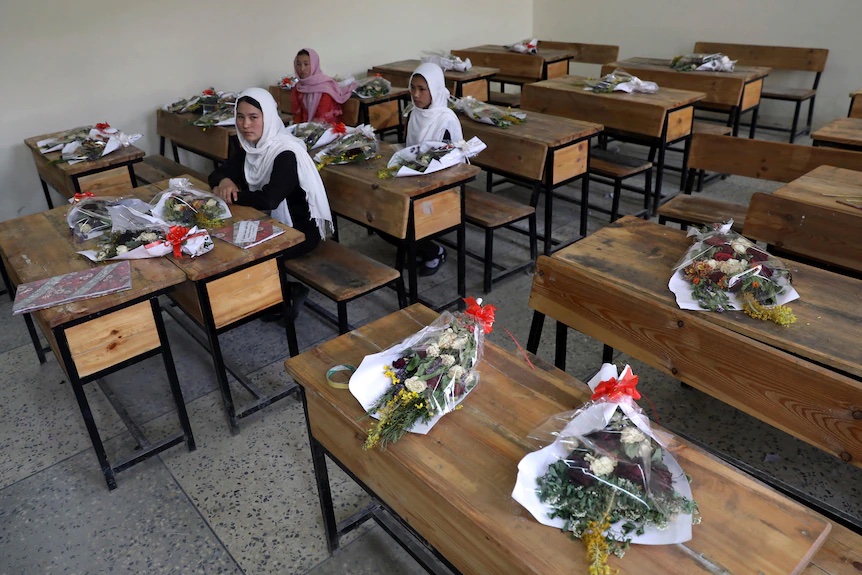
If you are looking for something different to read over the holiday period, you might want to check out the fabulous website of Words without Borders. The latest issue features short stories from four Afghan women writers among other things.

In modern Afghanistan, years of chronic instability and internal displacement have created a challenging environment for writers of all kinds. Twenty different flags have flown over the country since the beginning of the twentieth century. Changes in rulers, monarchs, emirs, and presidents, as well as revolution, Soviet invasion, and Taliban rule, have led to clashing political ideologies and the imposition of widespread restrictions not only on everyday life but on freedom of speech and expression, particularly for women.

All four writers mention the difficulty of finding the peace and space required to concentrate on writing. Finding the space to write is but one challenge; the war-scarred country feels permanently on edge, locked down long before the pandemic. This atmosphere is conveyed in Sharifa Pasun’s “The Decision,” and Maryam Mahjube’s “Turn This Air Conditioner On, Sir,” where just leaving the house can be a matter of life or death.

Peace negotiations between the Afghan government and the Taliban are deadlocked and the militant group continues to launch deadly attacks. Amid the surge in violence throughout Afghanistan the Taliban have denied they are deliberately targeting journalists, human rights campaigners, and women. This is clearly not true.

Joan Didion, my favourite essayist, said “I write entirely to find out what I’m thinking, what I’m looking at, what I see and what it means, what I want and what I fear.”  

By reading these four short stories on Words without Borders perhaps we will understand what some Afghan women are thinking and seeing, what they want and what they fear. We’ll understand lives different from our own and that can only be a good thing.