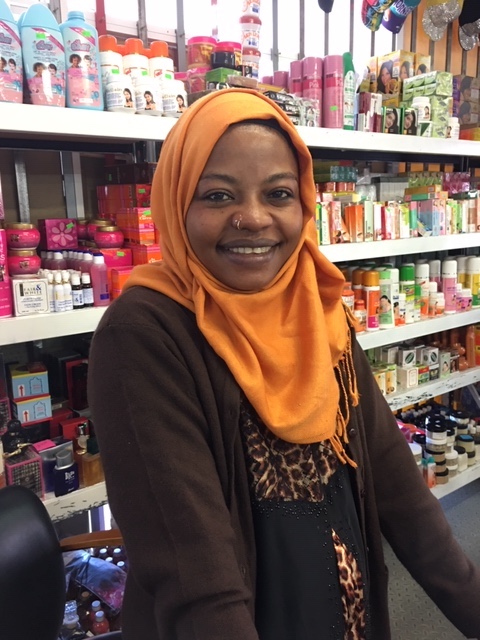
Amina’s story

“Australia is my home now, not Sudan.  Everything is normal here.  People don’t have guns pointing at you and your family.   I feel safe,”

Amina is a refugee from Sudan who escaped persecution to come to Australia with her husband and children.  After a very difficult decade for the family, in 2000 Amina’s husband explained to his family that they must escape from their country.  They could all see the violence was worsening.  Amina sighed and quietly told me: ‘you can’t live like that.’

“Our family needed to be safe and away from all the fighting.  We were locked in our home a lot of the time.   Villages, and even people, were being set on fire around us.  My husband travelled ahead of us to secure somewhere safe in neighbouring Egypt.  I was glad to get out.  I was scared of the violence, but I was also scared of what the future would hold for my family.”

Everyone settled in Egypt as best they could and seven months after fleeing the horrors of Darfur and claiming refugee status through the UNHCR the family were accepted as refugees by Australia for re-settlement.

“I didn’t know what to expect.  This country called Australia seemed so far away and we were leaving my mother, father, brother, and other family behind.  When we moved into our first rented place in Perth, we had nothing.  No furniture – nothing.  I couldn’t imagine how we were going to manage in this strange country as I spoke no English.  I persevered and gradually I began to feel better.  Australia was normal and safe.  There was nobody with a gun.”

She made an effort to become involved in new things and joined the language classes and other activities at the Edmund Rice Centre WA. “It opened my eyes to how life could be. Everyone was so friendly.   No-one was judgmental and it didn’t matter what country you came from, or what your religion was everyone was treated equally. It was like a big family. I knew I had found my place.  I had a family again.  I belonged.

Amina was very motivated to learn and grew in confidence working in a variety of different jobs as well as alongside her husband in his business over many years. Recently she decided to seek another employment opportunity in aged care. She gathered all her study certificates, most of which are qualifications for working with the elderly, wrote a resume, was offered an interview and was ultimately successful, returning triumphantly to celebrate her new job with her friends and family.

Amina has seven children who are all doing well at school and university.   Her husband owns and manages a retail outlet and they have called Australia home for nearly 20 years. I thought back to how Amina described herself when she arrived in Australia as a frightened, lonely woman who knew no-one. Over the years she has studied to become a successful businesswoman with a close knit, loving family.

“Of course, I am much happier now.  We are settled and in our own home and we have become Australian citizens. I’m still tired with all the work, of course, but that’s ok most of the time.”
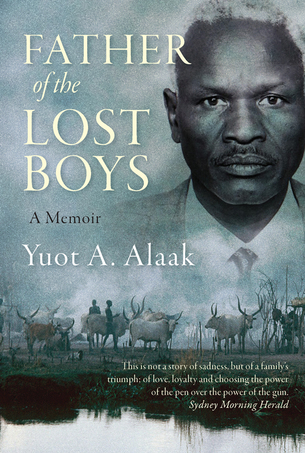
Father of the Lost Boys

Father of the lost boys is Yuot A. Alaak’s memoir of walking through the deserts and the jungles across three continents in Africa to seek safety after his home was destroyed in the second Civil War between North and South Sudan. 

I interviewed Yuot during the 2021 Festival of Literature and Ideas in Perth and had the pleasure of spending time with him while he shared his story.

It is a remarkable testament to his grit and fortitude, but it is also an ode to his father, who as an educator and important community leader in South Sudan, was responsible for leading 20,000 boys and associated refugee groups from Ethiopia to Sudan and on to the safety of Kakuma refugee camp in Kenya.

The group became known as ‘the lost boys of Sudan’ and for many years their story and suffering were unknown.  Yuot writes “we kept waiting for the United Nations to come and help us,. Often the boys were under attack from not only the North Sudanese but also from the military of South Sudan that wanted to recruit the boys as child soldiers. Yuot himself trained as a child soldier when he was nine years old.

The boys first became refugees when they reached Ethiopia. During this time Yuot’s father was imprisoned and tortured. They were told by radio that he was dead and believed this to be the case for many years. Thankfully, his father lived and managed to find his way to the family and the lost boys.  He took on a leadership role with the refugees. Yuot’s father always said, “the pen is mightier than the sword” and did all he could to keep the boys safe from various opposing forces.

Organising his charges into groups of 1,000 with a head teacher, several other teachers, head boys and a few soldiers, he marshalled the big groups of boys in a military like operation to criss-cross various countries.

One of the more gripping parts of this memoir is the crossing of the Gilo River by the group. Fighting a swollen river with strong currents, Yuot’s father obtained twelve canoes and in a mass exodus they shuttled as many boys as possible across the river in canoes all day and all night. Some of the boys swam across on their own and they feared for their lives. Some drowned and some were taken by crocodiles.   In the end not all escaped as they were fired upon by competing armies.

Yuot writes passionately about the rest of their trek and arrival at Kakuma where they were the first refugees in the camp. Now decades later the refugee camp houses 180,000 people. 

His pride in his father, who is truly a remarkable man, shines through.  Eventually all the family were reunited and Yuot explains how they escaped to Nairobi where they still feared for their lives.  They were finally accepted as refugees by Australia years later.  

This is a story of triumph. There is humour too, as Yuot describes settling into his new home and learning what it meant to become an Australian.

Yuot arrived in Australia at the age of 14 and spoke no English.  He went on to learn the language, finish Year 12, and be accepted to university where he obtained degrees in engineering and geoscience.  He now works for one of Australia’s largest mining companies and enjoys writing.

This is an inspiring read and the publisher Fremantle Press has provided some great book club notes.