The Death of Hope

According to the latest figures I could find from the UN, in the last three years 1,000 humanitarian aid workers have been killed. Of those deaths more than 560 were in Gaza and the West Bank, 130 in Sudan, 60 in South Sudan, 25 in Ukraine and 25 in the Democratic Republic of Congo. 

This horrific death count is triple that of the previous three years. And still the numbers rise.

This is an untenable situation. These humanitarians were killed while distributing essential food, water, medicine and shelter. They died in clearly marked convoys and on missions co-ordinated directly with authorities. And all too often they were killed by member states of the United Nations.

Tom Fletcher, Under Secretary General for Humanitarian Affairs and Emergency Relief Co-ordinator for the UN, says “this is not an accidental escalation – it is collapse in protection.” He goes on to ask: “is it because member states see these numbers as collateral damage, part of the fog of war? Or worse still, are we now seen as legitimate targets?”

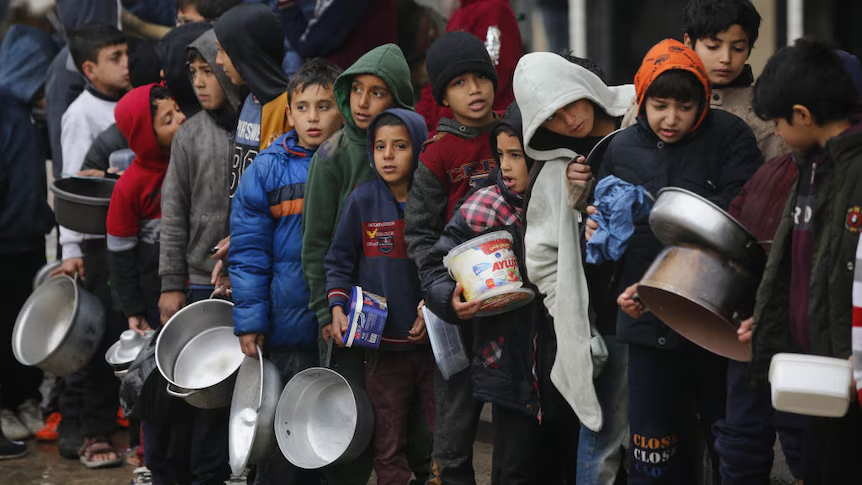
Across multiple crises, humanitarians are not only being killed, but their action is also being restricted, delegitimised and penalised. And of course, when humanitarians are harmed, aid often stops – clinics close and food doesn’t arrive.

Did you know that in Yemen, 73 UN and dozens of NGO personnel remain arbitrarily detained by the Houthis? In Afghanistan and Yemen, women humanitarians are prevented from doing their jobs. In Gaza, Israel restricts UN agencies and international NGOs. In Myanmar, security and access constraints cut off aid to over 100,000 people in a single month. And in Ukraine, drone attacks have forced aid groups to pull back from frontline communities.

In all these cases, the deaths of humanitarian workers often leads to the death of hope for millions who rely on them. 

Without hope how can we keep going? Yet aid groups and NGOs do keep going, often under horrendous circumstances. We owe them our deep gratitude.  

Rather than feel helpless I donate to one of the best NGOs I know – Médecins Sans Frontieres who work across war zones. But of course, there are many others that make a significant difference in so many lives – Oxfam, Red Cross and Save the Children to mention a few. 

I urge you to consider supporting their work, reading about their work and talking to others about it. By holding our hope, essential aid can continue to flow so those caught up in conflicts and disasters can continue to hope for peace and safety.
Medecins sans Frontieres

This week I attended a briefing from Medecins sans Frontieres (Doctors without Borders) on their work around the world and came away humbled.

Medecins sans Frontieres (MSF) is an independent, international medical humanitarian organisation that provides emergency aid to people affected by armed conflict, epidemics, natural disasters and exclusion from healthcare.  

It’s not just doctors, with many other medical and operational staff working for the organisation, all of whom account for over 50,000 full time staff in 37 countries.

Of the 120 Australians currently working in the field for MSF, two addressed the briefing. One is a community psychologist who has just returned from a year in Bangladesh at the world’s biggest refugee camp Cox’s Bazaar, and the other a project director who has worked in many crisis situations such as Afghanistan and South Sudan organising sanitation, roads and facilities for the medical staff.  

The information they covered in the briefing provided a window into the scale and reach of their work and the difference they make in so many people’s lives. In South Sudan alone MSF operate one of the largest assistance programs worldwide and ran 12 regular and five emergency projects delivering a range of services. MSF teams responded to numerous disease outbreaks including measles, yellow fever, Hepatitis E and Cholera. There were numerous surges in malaria cases and an unusually high number of admissions of children suffering malnutrition.

In one example, Dr Ahmed Mahmoud Al Salem observed the dramatic deterioration of the mental health of Palestinians after 7 October 2023.  “This is not a normal trauma; this is a huge tormenting catastrophe,” he said. 

My husband and I have been donors to MSF for over ten years. If you’re thinking of supporting a charity, I urge you put MSF top of your list

Disease knows no borders

Polio has re-emerged in Gaza after 25 years. In Yemen there has been a dramatic surge in measles.  

Conflicts, collapsed health systems, interrupted supply chains and a range of other factors including COVID, have resulted in low routine vaccine coverage around the world and an increased spread of infectious diseases. Children are especially affected.

Untreated measles can lead to serious complications like pneumonia, blindness and brain damage. According to Médecins Sans Frontieres (MSF) more than 100,000 children globally, mostly under the age of five, died from measles in 2023. They also report that since 2022, Nigeria has been at the centre of a diphtheria outbreak brought about by low vaccine rates.

Most of us are lucky.  We live in parts of the world that are safe and healthy with high vaccination rates. I can only imagine what it is like to live in a conflict zone requiring help all the time with food, water, health, and infrastructure.

News that the US government is defunding the World Health Organisation (WHO), and other essential United Nations agencies has brought even more uncertainty for people who rely on humanitarian assistance. The US has also suspended nearly all foreign aid programs.  

The World Health Organisation has led eradication efforts for some of the world’s cruellest diseases including polio and smallpox and aims to eliminate a further 20 diseases by 2030. 

But what will happen now without significant funding to WHO and the many partner organisations?  

Katrina Penney, President of MSF Australia says “we are most concerned about people who rely on essential services for survival. The World Health Organisation is a key partner in the international humanitarian system.” 

The consequences for the world’s most vulnerable people are dire. It’s important we support the work of MSF, Red Cross, Oxfam and other agencies working in this age of uncertainty. 

Disease knows no borders. The world knows this from our experience of the COVID pandemic. It’s time to step up.

Young girl getting vaccination from a health care professional