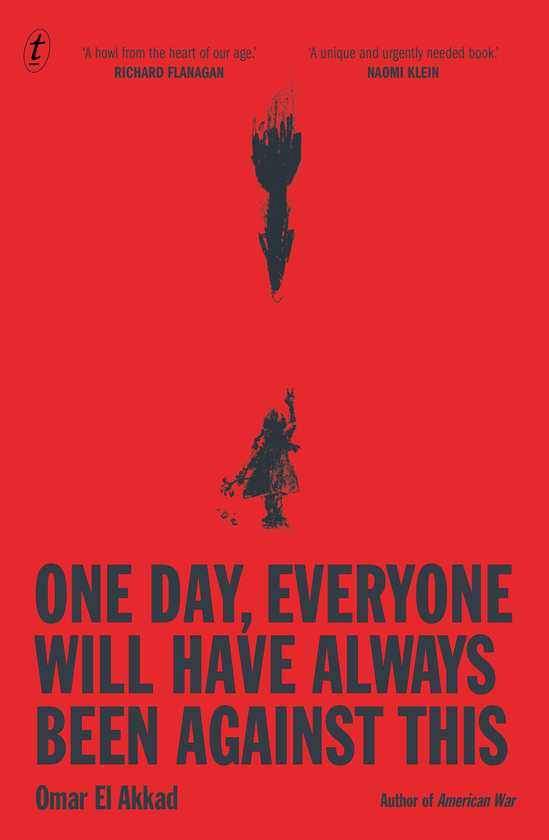
One day, everyone will have been against this

The good thing about holidays is that there is time for reading. Over my break I read One day, everyone will have been against this by Omar El Akkad and urge you to read it. My good friend from the Centre for Stories Caroline Wood gave it to me as we sat despairing about the state of the world, working our way around all the conflicts and humanitarian crises in the world and wondering how this could all be happening.

Naomi Klein wrote: “It is difficult to understand the nature of a true rupture while it is still tearing through the fabric of our world. Yet that is what Omar El Akkad has accomplished, putting broken heart and shredded illusions into words…”

One Day is passionate, poetic and sickening. It is full of well-earned rage, frustration with those who need this morality to be spelled out. For me it was cathartic. It is an important book, a must-read, if only for the reminder that history always comes down to one simple question: “When it mattered, who sided with justice and who sided with power?”

El Akkad was born in Egypt, raised in Qatar and Canada, and is now a US citizen, he has reported from the Middle East, Afghanistan and Guantánamo. This book is a response to events in Gaza after 7 October 2023. Like El Akkad, I despise Hamas and the authoritarian governments who use Islam to crush women, minorities and peaceful Muslims. I have written extensively about the treatment of women in Afghanistan by the Taliban. El Akkad says he can’t stomach the lie that the west is a civilised party in the Middle East.

I know some people will disagree, but I always think it is good to get away from your normal news feed and read something different. It’s for that reason while I was away in France, I watched Fox News as well as my usual feed of CNN and the BBC. I am trying to understand both sides in all conflicts, but it’s hard when people are being massacred and killed by one side under the name of democracy.

I wake up each day and look at my news feed to see what Donald Trump has done while I was sleeping. He is singlehandedly rupturing the world, just as Naomi Klein wrote. El Akkad asks us who is doing what and why around the world. Can we stand by and watch passively? 

He focuses heavily on the harm to innocent children, so this is not an easy book to read. As Richard Flanagan writes “this is a howl from the heart of our age…it seeks to describe the indescribable and make coherent an increasingly incoherent world.”  I hope you’ll read it. 
Celebrating Human Rights

“Human rights are our compass in turbulent times — guiding and steadying us through uncertainty.” 

This quote is from United Nations Human Rights Chief, Volker Türk at the launch of the 2025 Human Rights Day campaign.

Held on 10 December, Human Rights Day marks the anniversary of the adoption of the Universal Declaration of Human Rights by the United Nations. It’s a day to commemorate, educate and reflect on the rights that allow people to live safely and with dignity. In Australia we tend to take many of our rights for granted – such as the right to an education, the right to receive medical care, and the freedom to practice our chosen religion. However, the reality is they are not equally available in many parts of the world, including Australia. 

In 2025, the very foundations of human rights have been put to the test in a myriad of ways. “Inequalities are rising, conflicts are raging, the climate emergency is mounting, and some are creating and trying to deepen divisions within societies and between countries” said Türk. “It is crucial to keep advocating for our fundamental rights.” 

The Australian Human Rights awards are a true celebration of people across the nation who’ve made it their life’s mission to champion human rights, social justice, and equality for all. The winners of the 2025 awards announced last week, represent the very best of who we can be. 

  • Human Rights Medal – William Tilmouth (NT): For dedicating his life to reform, justice, opportunity and self-determination for First Peoples. William has led numerous community organisations and is the founding chair of Children’s Ground, a First Peoples-led reform movement. William is a member of the Stolen Generation and was NAIDOC Male Elder of the Year in 2023.
  • Law Award – Elisabeth Armitage (NT): For her work as Coroner and judge in making institutions accountable for upholding human rights and removing barriers so every citizen can enjoy full, safe and equal lives.
  • Media and Creative Industries Award – Ben Doherty (NSW): For reporting on human rights and humanitarian issues, from domestic servitude to experiences of forced migration and asylum.
  • Community Award – Ramnik Singh Walia (NT): For advocating for inclusion and accessible services for older people, people with disability and First Peoples, especially in remote areas.
  • Young People’s Award – Shakira Robertson (Tas): For her trauma-informed work to prevent domestic and family violence and transform Tasmania’s systemic response.

Find out more about each winner and nominee and the wonderful work they are doing on the Australian Human Rights Commission website

Medecins sans Frontieres

This week I attended a briefing from Medecins sans Frontieres (Doctors without Borders) on their work around the world and came away humbled.

Medecins sans Frontieres (MSF) is an independent, international medical humanitarian organisation that provides emergency aid to people affected by armed conflict, epidemics, natural disasters and exclusion from healthcare.  

It’s not just doctors, with many other medical and operational staff working for the organisation, all of whom account for over 50,000 full time staff in 37 countries.

Of the 120 Australians currently working in the field for MSF, two addressed the briefing. One is a community psychologist who has just returned from a year in Bangladesh at the world’s biggest refugee camp Cox’s Bazaar, and the other a project director who has worked in many crisis situations such as Afghanistan and South Sudan organising sanitation, roads and facilities for the medical staff.  

The information they covered in the briefing provided a window into the scale and reach of their work and the difference they make in so many people’s lives. In South Sudan alone MSF operate one of the largest assistance programs worldwide and ran 12 regular and five emergency projects delivering a range of services. MSF teams responded to numerous disease outbreaks including measles, yellow fever, Hepatitis E and Cholera. There were numerous surges in malaria cases and an unusually high number of admissions of children suffering malnutrition.

In one example, Dr Ahmed Mahmoud Al Salem observed the dramatic deterioration of the mental health of Palestinians after 7 October 2023.  “This is not a normal trauma; this is a huge tormenting catastrophe,” he said. 

My husband and I have been donors to MSF for over ten years. If you’re thinking of supporting a charity, I urge you put MSF top of your list