The voices of Western Australia’s culturally and linguistically diverse (CaLD) youth have been recorded in a really interesting new report, recently launched by Citizenship and Multicultural Interests Minister Mike Nahan.
The report outlines recommendations from WA’s first CaLD youth forum – the Catalyst Youth Summit – held in February and attended by 46 WA delegates from 22 countries of origin.
The summit’s focus was to bring together young people to work on solving issues that affect them. The five key areas discussed were discrimination, access to opportunities, refugees and asylum seekers, mental health and a sense of belonging.
The report’s recommendations include the need for cultural competence training for CaLD youth-related service providers, and the importance of creating opportunities for young people from CaLD backgrounds to share their stories and have their voices heard.
One of the really enjoyable aspects about being a writer is that I get to visit schools and talk to students. More to the Story– conversations with refugees is being used in a number of high schools around Australia for English, social sciences and a number of other subjects. The response from students and teachers has been heartening.
Recently I visited Churchlands Senior High School in Perth and was so impressed with how the teaching staff were approaching the topic. Apart from reading chapters of my book (which was lovely to see), they had also watched some of the SBS programme Go back to where you came from, as well as examining speeches by Julian Burnside QC, information on the Commonwealth Department of Immigration and Border Security website, different media reports and the Refugee Council of Australia website. The context for several classes was ‘making choices’ which explores the formation and influence of values and attitudes in individuals and society. A number of others were also looking at the power of language and how it is used to empower and disempower.
I find young people ask very different questions compared to adult audiences. I have to say there also seems to be more astonishment and outrage that Australia treats asylum seekers as it does. As one student said to me: ‘I just can’t understand why we treat people like this – it is a fundamental human right to be able to seek asylum. How does this happen?’
There also tend to be more personal questions about the individual people I have written about. For example: What happened to John’s mum in Afghanistan? Why can’t she come to Australia? Why couldn’t Paul immediately apply for refugee status when he escaped Burma? What do kids like us do in a refugee camp? Do you keep in contact with the people in your book? Are they your friends?
I am always pleased to explain yes, the people I have written about in my book have become friends and my life is richer for it.
We have a page for schools on this website (under Resources in the menu) which contains information for teachers on school visits, some teaching notes and a contact form for those interested in me visiting their school.
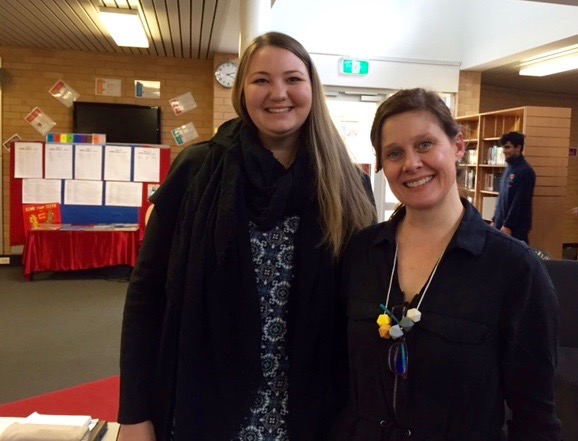
Emma Lawson and Melanie Postmus, two of the lovely teachers at Churchlands Senior High School
I was thrilled to see that Right Nowhas recently published a very positive review of my book linking it to the on-going debate about refugees and asylum seekers in Australia. Even though the book was published in November last year, these human stories continue to be lived and repeated over and over again, every day, in most parts of the world.
Right Now is a volunteer, not-for-profit media organisation that focuses on human rights issues in Australia. It bases its work around the belief that creating a positive, rights-respecting culture in Australia begins with the flow of information. I particularly like and relate to their vision: An Australia where people have informed and inspired discussions about human rights, equality and justice. Right Now’s work is vitally important and it is well worth following if you have an interest in human rights.
Here are some extracts of the review:
“More to the Story: Conversations with Refugees is a vital contribution to understanding the complex tapestry of the human experience that refugees bring with them when they embark on their journeys and settle in their new countries.”
“More to the Story: Conversations with Refugees expertly weaves together not only conversations with refugees but the historical and socio-political backdrops that have forced them to flee their countries for shelter in Australia. As Australia’s treatment of refugees and asylum seekers increasingly becomes a political and moral issue, it is well worth reading this book to hear authentic voices.”

 More to the Story